Big Bend
Park 34 | March 2025
I’m sitting in Chisos Basin Campground at Big Bend National Park, a whisper of a breeze lifting strands of my hair across my face before I tuck them back behind my ears. The sun is warm on my back. A roadrunner tiptoes through a neighboring campsite, searching for food scraps under the picnic table. Overhead, turkey vultures endlessly circle; I idly wonder what they might be searching for.
This is our thirty-fourth National Park and it’s unlike anywhere I’ve been. After driving hours through the windswept plains of West Texas — from Guadalupe Mountains National Park, where we woke and summited Guadalupe Peak, south through Van Horn and Marfa and Alpine — we reached the remote entrance to Big Bend, which is named very literally for an elongated curve of the Rio Grande River that runs along the southern edges of the park, drastically changing the course of the river from flowing southeastern to northeastern. The river, also known as Rio Bravo del Norte in Mexico (“the fierce river of the north”), marks the boundary between the United States and Mexico.
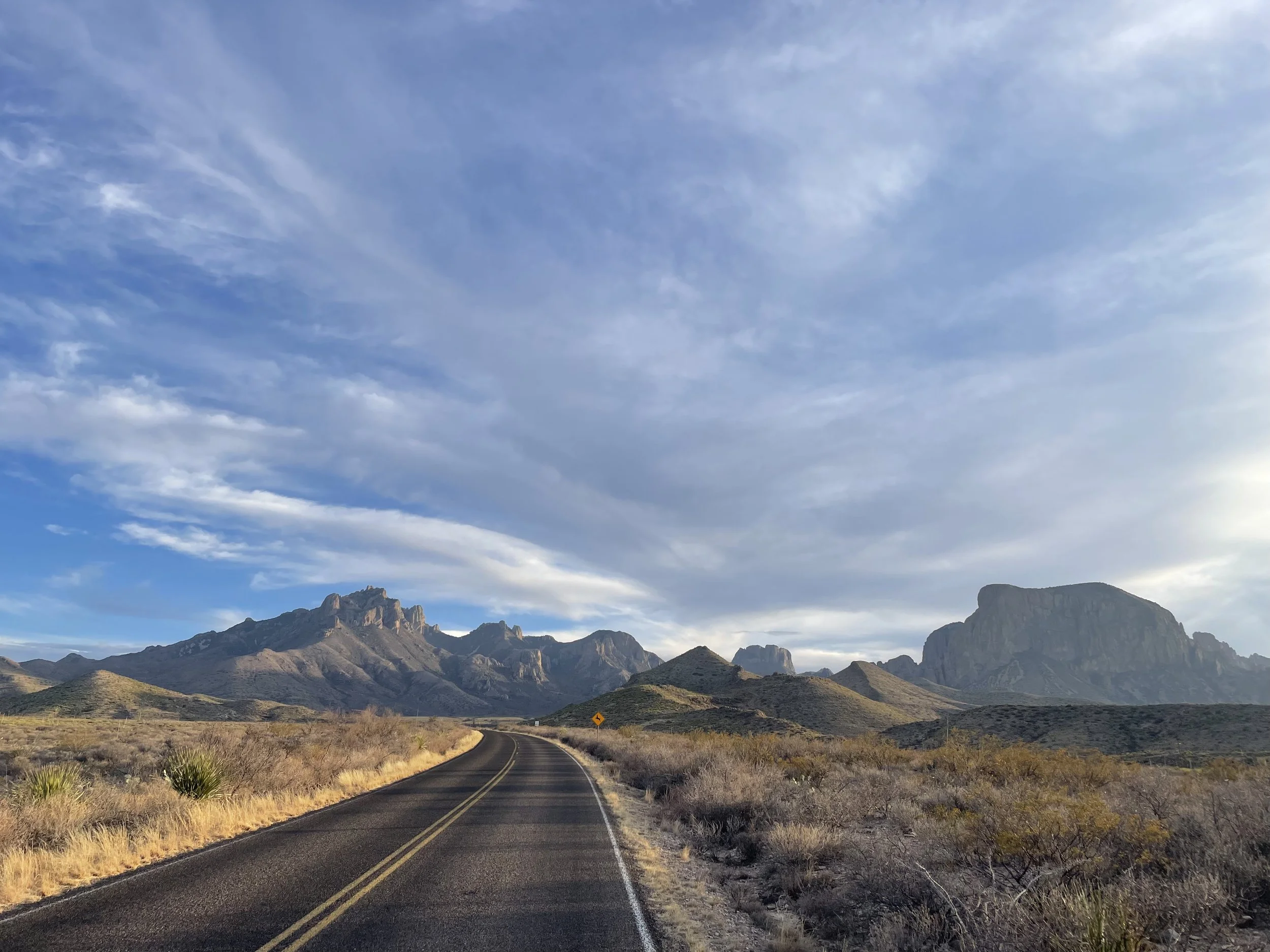
There are three main campgrounds in the park, but my initial research had quickly led me to Chisos Basin. Everything that is known of my ancestral line informs me that I come from Northern hemisphere mountain and ocean people. In other words, the opposite of the Chihuahuan Desert landscape we were driving into. Two of the campgrounds at Big Bend are located closer to the river, which is often a full twenty degrees Fahrenheit warmer than the third campground, which I had read is located in the Chisos Mountains. Say less. I’d managed to snag us a spot at Chisos Basin, but had no idea what to expect when we first entered the park a little before sunset. I was awed and a little giddy when the Chisos range came into view — a mountain oasis rising up out of the middle of the desert, burnished golden in the early evening light. A single road snakes up into the dramatic peaks, where soon the landscape becomes a little greener (the cooler temperatures might fool you, but it’s still part of a desert ecosystem) and there are signs for black bears and mountain lions and white-tailed deer. My mountain-loving heart feels at home and my heat-averse body breathes a sigh of relief.
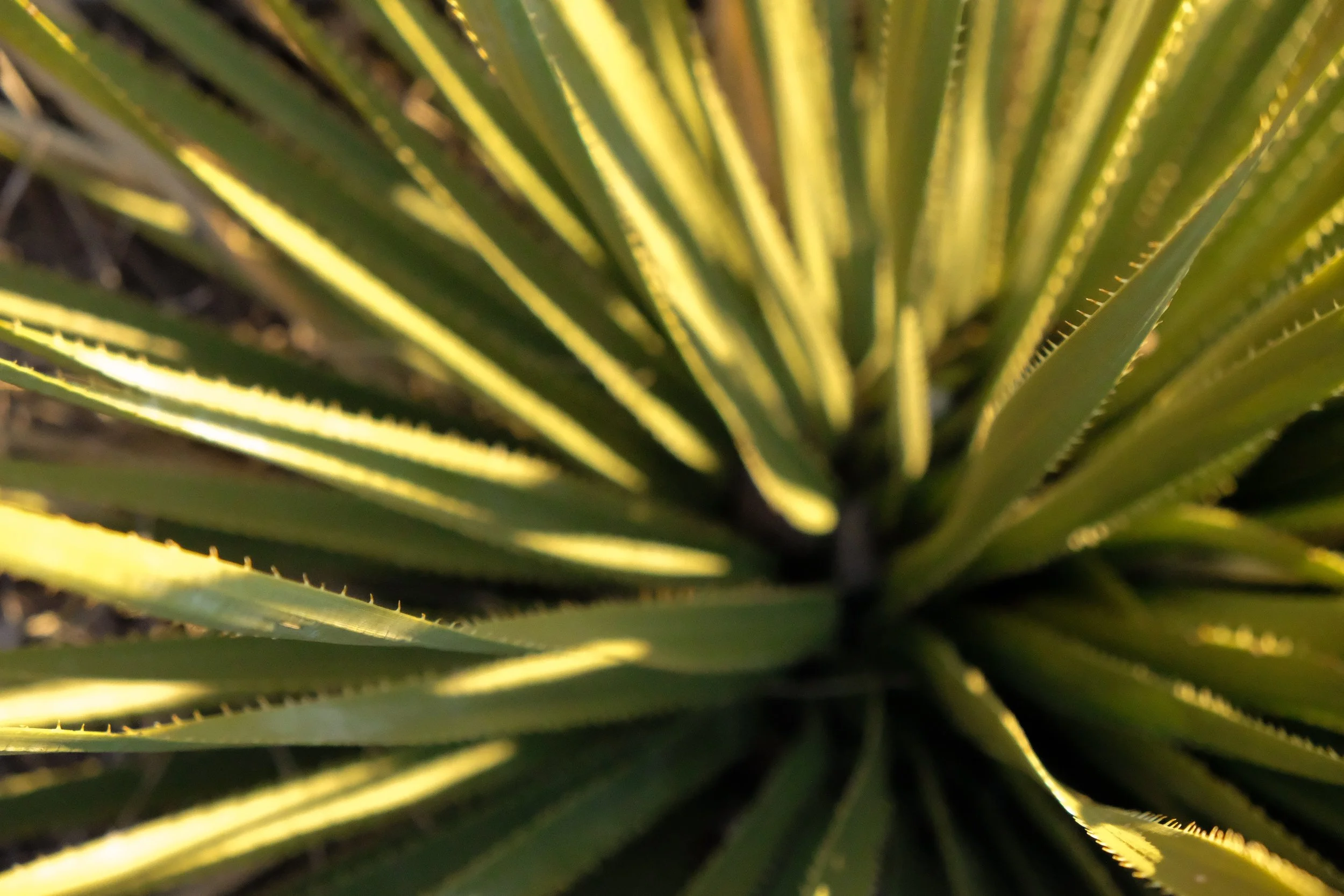
The campground itself is nestled in a valley, almost completely encircled by a ring of arid mountain peaks that are studded with dull green creosote bushes, yellow yucca and sotol, purple prickly pear cacti and other flora that I don’t know but are known by this land. It’s 6:30 pm, and the sun is beginning its lazy descent across the sky, slowly inching toward “the Window” — a singular west-facing break in the circle of mountains that provides a perfect frame for sunset every night.
This natural feature delights me. One of my favorite experiences — while at national parks, while camping, while traveling, but also just during my regular walking around life, when I remember to pay attention — is seeing how I and other humans still seem to be awed by a sky streaked with color. What is it about this twice-daily phenomena that stirs us, calling us to stop or to wake early, inviting us to make the trek to a bench or a balcony or somewhere with a good view, and watch the sky?
I’m not sure, but it’s one of the things I find myself clinging to these days. It gives me a fleeting shot of hope that we’re not entirely numb, that technology hasn’t fully corrupted us, that we, as a species, still find ourselves responding to and situating ourselves within nature in ways that are simply appreciative and not destructive.
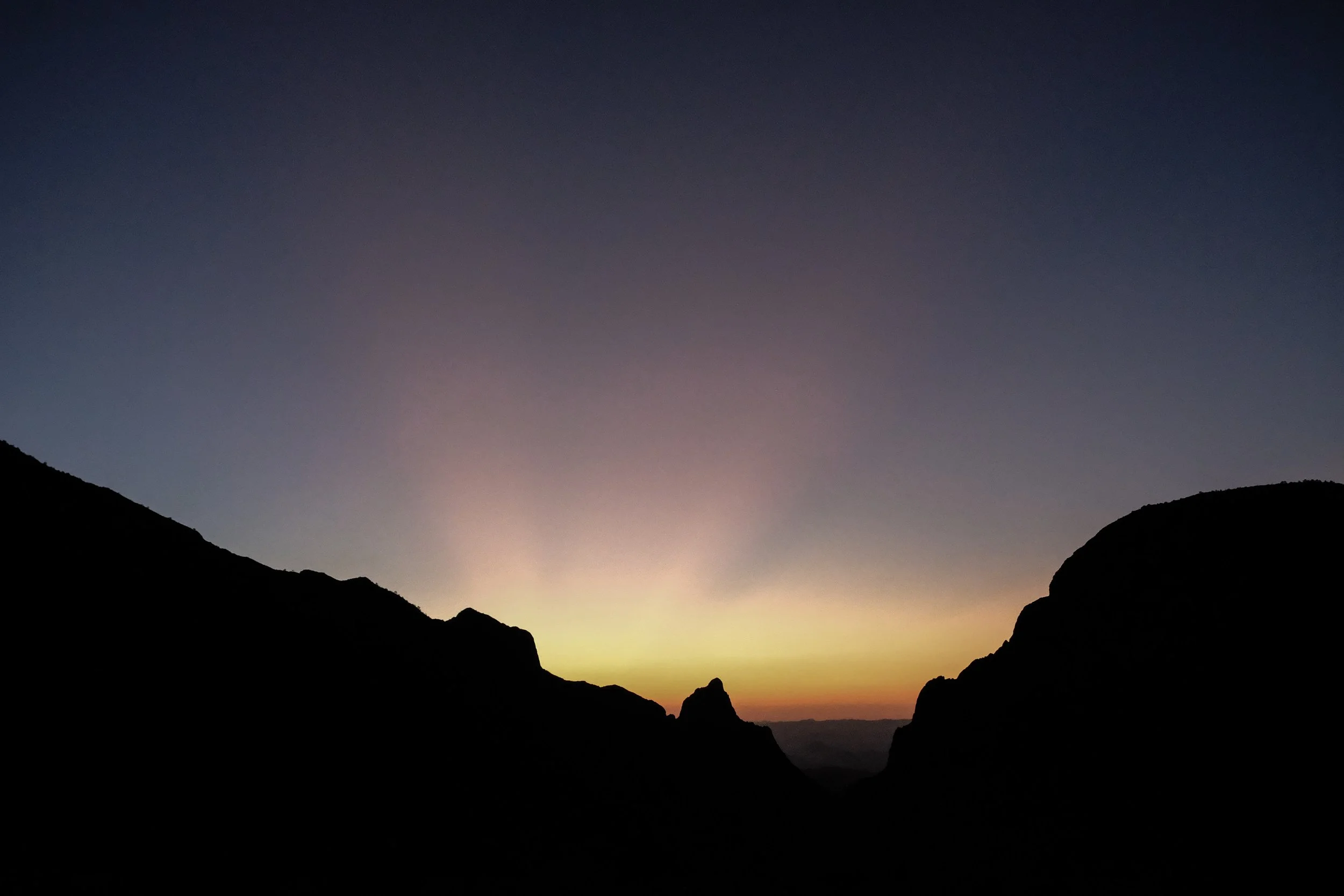
Hours later, the last of the vibrant sunset — a magnificent display of bold magenta and soft peach and lavender — fades behind the sliver of horizon that can be seen through the Window. One by one, the stars begin to blaze to life. They seem brighter and nearer and colder and more beautiful than ever, a perk of Big Bend having earned International Dark Sky Park recognition.
I wish I could stay awake all night and watch them, these pinpricks of light that are so far from us, yet make up such a recognizable part of our world. I’ve been finding the “easy” constellations — Orion’s Belt, the Big Dipper, the Little Dipper, and the steady glow of Polaris, the North Star — since I was a little girl. I think about wayfinders who have used these familiar points to guide their journeys for generations. I stare at the North Star and feel a luminous tether between me and the countless others throughout time who have also looked at that same light for guidance and direction. I’ll never know who they are, yet still feel a brief, profound sense of interconnectedness.
What would it be like if all the stars burned out and all we had was a night sky without these celestial lights? Such a thought experiment helps me identify the sense of piercing loss I would feel if such a thing were to occur. I’d miss the stars. I’d feel unmoored under this unfamiliar sky. I’d grieve. Sometimes it takes the idea of loss to remind you how much you care for something, how unmade you’d feel if it was gone.
My thoughts turn a little cynical. Might we also find that sense of care for the Monarch butterfly, honey bees, sea ice, and black rhinos? Might we all think a bit more seriously about what this world would be like without polar bears or Arctic terns or Salish Sea resident orca or salmon returning home? What happens when entire nations are displaced by rising tides — when our world becomes one in which Tuvalu or the Maldives or the Marshall Islands become nations without land? What happens when New York and Miami and New Orleans can’t hold the inexorable sea at bay any longer?
I don’t know the answers to any of these dark questions and won’t stay awake all night trying to. Eventually I fall asleep, watched over by a sky that for now still sparkles with these ancient, familiar lights.
Although Big Bend is best known for things like the Rio Grande, its starry skies, long expanses of the Chihuahuan Desert, and the Chisos Mountains, I found it hard to disentangle it from the current environmental and political context. I don’t think it can or should be separated from that, to be clear. Every time we are in a national park or forest or interacting with some kind of “protected” place, it is, first and foremost, stolen land. There has been a lot of excellent thinking and writing already done on the dissonance between the rhetoric and actions of the (generally white-led) conservation movement and Tribal sovereignty, including but not limited to the Land Back Movement. This is a tension that I believe should be understood and held in the forefront of one’s mind especially if you are a settler, as I am. It matters everywhere, including in Denver where I live and work. But I feel it even more acutely when on so-called public lands, which have invariably been taken from their original inhabitants, often with force, sometimes under the guise of environmental protection.
Beyond this foundational reality, there are other matters on my mind. I am trying to stay off my phone for the few days that we are away, and the cell service is pretty bad, so it hasn’t been too hard. But I know the headlines continue to roll in and the news they carry isn’t good. It’s an utter privilege to take time to “get away” and I feel guilty about it at times, even as I recognize the importance of building in rhythms of rest, recovery, and care for ourselves. This is important in order to continue engaging with the hard work that faces us, yes, but also just because ease and kindness and softness and joy are fundamentally beautiful things that I wish for all humans to experience and prioritize.
Staying off my phone has marginally helped, but this environment brings me right back to the political context I can’t leave behind. Both of the parks we visited on the trip were understaffed. Each visitor center was operating on reduced hours. Guadalupe Mountains had let go of all but one ranger in response to funding cuts from the federal government. A bright spot was the volunteers who had come out of the woodwork to continue emptying the trash, cleaning the bathrooms, and staffing the visitor centers.
Outside of the park boundaries, we passed at least half a dozen border patrol trucks on our drive to Big Bend; eye-catching white vehicles branded with the incongruous phrase “Honor First.” They crept down long dirt roads criss-crossing the land, red dust billowing up behind them into the azure sky. A statement. A reminder. A warning.
We visited a section of the park where the Rio Grande was barely flowing, much of it sitting in stinking pools overgrown with algae, an inglorious downstream reality of a river that has been forced to conform to human demands. Just a few weeks earlier, we’d been in Monte Vista, Colorado, relatively close to the Rio Grande’s headwaters in the San Juan Mountains. Between there and here, the river is heavily dammed and redirected and siphoned off mostly for agriculture across New Mexico and Texas. The result is that by the time it gets to this part of Big Bend, the Rio Grande looks like a terminally ill river. It has been listed as one of the ten most endangered rivers in the world by the World Wildlife Fund. I felt a mixture of ineffable sadness and deep worry when seeing this.
On the other side of the river bed was a family that had set up a shaded taco stand, presumably to entice park visitors in search of a snack. The handwritten sign reads: “Tacos — 10 pesos.” A child was throwing a football back and forth with one of the adults, directly across from us. When looking at things through a purely logistical lens, they could easily walk to us across the river bed, or we could walk to them. The one stream of flowing water was hardly knee-deep at its deepest point. Adding in the unavoidable political lens, we knew it wasn’t so simple.
It felt surreal that this somehow marked the end of our nation and the beginning of theirs. Humans have drawn lines on land and rivers and written laws and policies that require specific documentation to cross this otherwise invisible demarcation. Even more surreal was that we could see cows and dogs and birds and wildlife of all kinds freely moving from one side to the other. This is the border that we hear about on the news, this is the line that has caused so much political posturing and fear mongering, this is what the man currently occupying the White House has whipped so many people into a frenzy over and used as justification for his inhumane executive orders, deportation directives, and the flouting of international law.
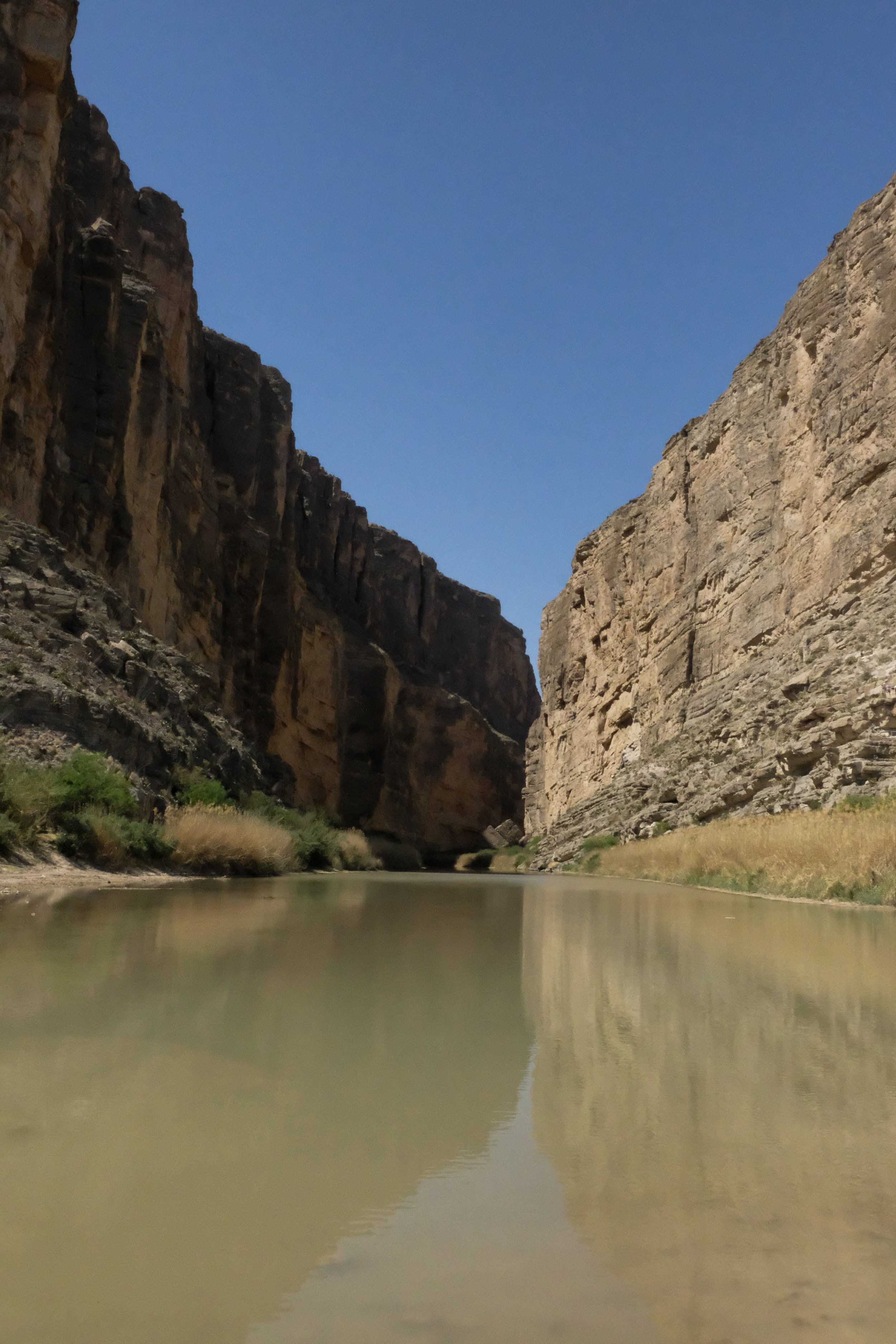
It’s been said that the personal is political, or that “everything is political.” This feels even more apt a premise when traveling to a remote national park that is still not remote enough to avoid being the site of land theft (several times over), defunding, border politics, a fragile desert ecosystem that is only getting hotter, and a river on the verge of death. This is a truth, alongside the other truth of this place’s stark and harsh beauty: Those blazing stars, this mountain oasis, the tall terraced canyons that used to be ocean reefs, and the wide open skies.
Our last morning in the park found us parked at the trailhead of Lost Mine Trail before sunrise. With only about twenty parking spots and epic views promised, this was one of those “early bird gets the worm” hikes. We also had vested interest in completing this hike early so we could squeeze in one more trail before it got too hot. J and I drank our coffee in the dark of the car before strapping on our packs and setting off up the trail as the horizon began to brighten.
There are few things that make me feel more alive than when I’m hiking. I love the feeling of my muscles warming up, breathing in the fresh air, the reward of wonder and joy when reaching a new viewpoint. This was one of those mornings. The sun was now shining, but we hiked in the shadow of the mountains for the majority of the time. Piñon jays flitted around in the trees, their feathers a bright spark of vibrant blue. White-tailed deer, which we’d learned are effectively marooned in these mountains along with the mountain lions and black bears since they rarely go below 4,500 feet of elevation, munched on brambles within thickets off the trail. We talked easily with each other, listing favorite memories from other camping trips we’d taken over the years, marveling at the passage of time.
When we reached the top, the sun’s rays touched us for the first time. Golden hues, warm like honey, washed over us. We traipsed across the smooth rocky ledge, a breeze picking up around us. Before us lay the undulating peaks of the Chisos Mountains, followed by endless desert as far as our eyes could see.
Deserts are not and may never be my preferred landscape, but these days spent in the heart of the Chihuahuan Desert left their mark. Just as it sometimes takes the thought of losing something to truly appreciate it, I departed Big Bend with a renewed recognition of the preciousness of water and a reminder of the precarious balance of life, human and more-than-human alike.
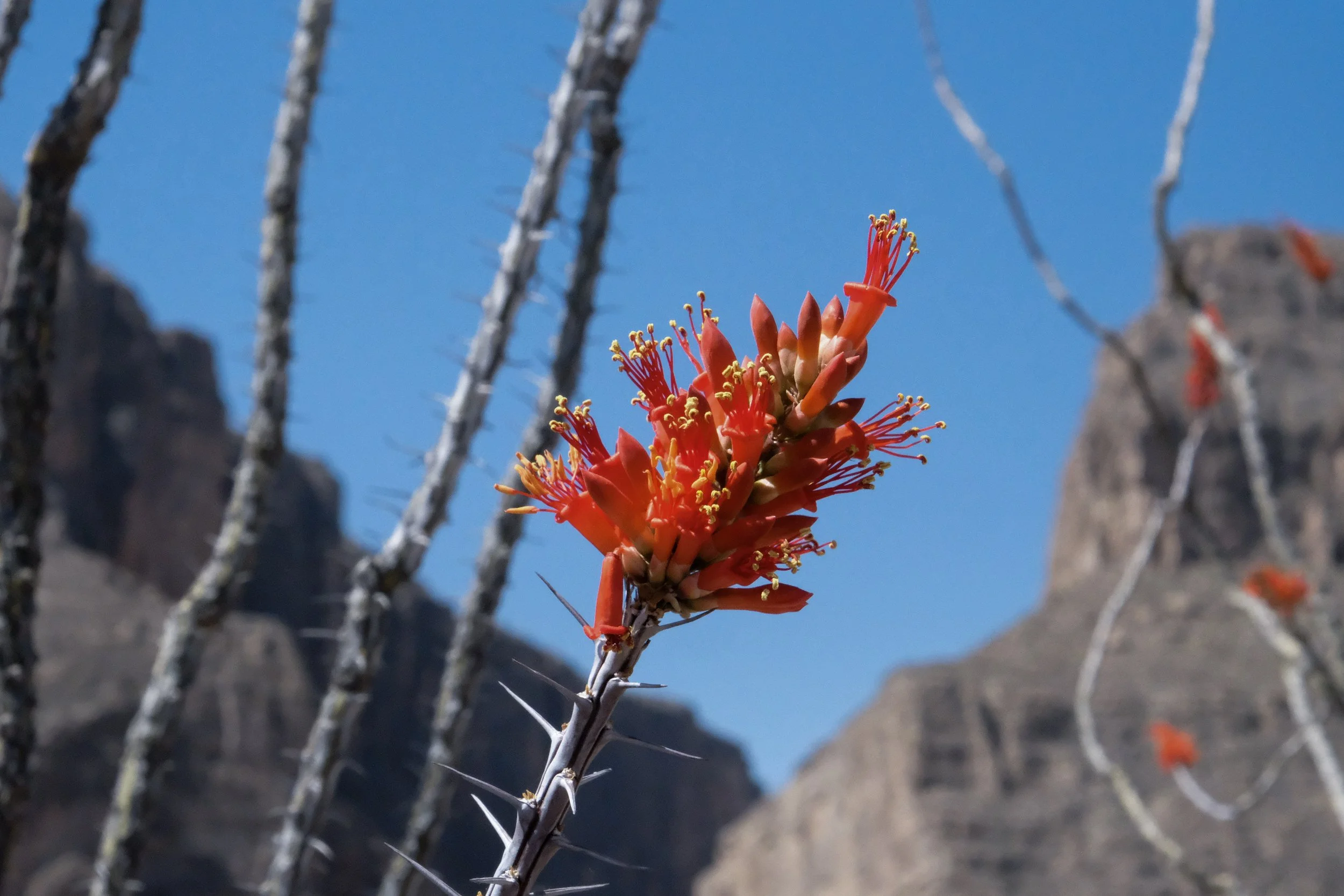
I find courage in the example of this land. The river runs drier than ever, yet trees are still greening up in the Rio Grande basin. Resources are scarce, so the roots of the plants sometimes dig more than 150 feet deep to find what they need to survive. And no matter the heat, no matter the water scarcity, every spiny, dead-looking plant bursts into vibrant color when springtime arrives. There are few images more strikingly beautiful than a blood-red ocotillo blooming defiantly against the brown desert landscape. There is such grace and defiance, resilience and fierceness in this harsh place.
These times are hard. Perhaps we too need to let our roots run deeper than ever before to find what we need in order to continue resisting—and envisioning something beyond what we are resisting. Perhaps we too must choose to bloom, to celebrate, to have joy, even when the days are dark. And maybe someday, this kind of fortitude and resilience and courage and vibrance sets us on a path toward a future we can only dream of now. Perhaps one with fewer dams and more free-flowing rivers. One with cleaner energy and kinder, more humane policies. One with salmon runs and clear starry skies and just economies and walkable cities and fresh food from the Earth to nourish us all. Perhaps.
We drank in the views from the summit, one last 360-degree panorama. A raven soared at eye-level with us, one black eye fixed upon us. I met the raven’s gaze and watched as he disappeared into the valley.
Following suit, we turned and began the long climb down.